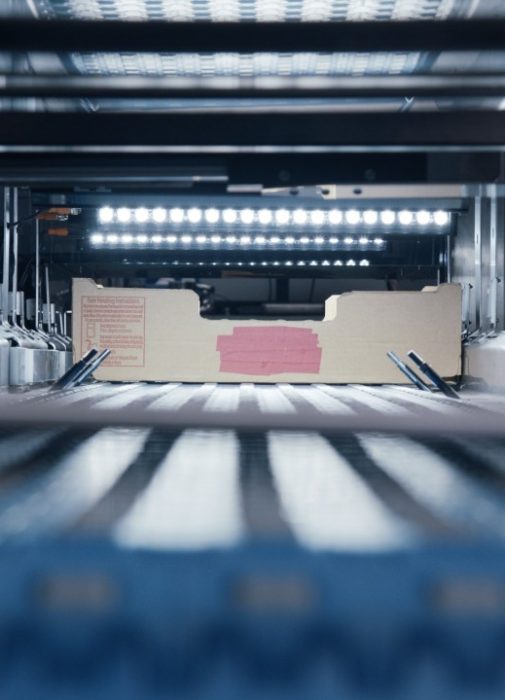
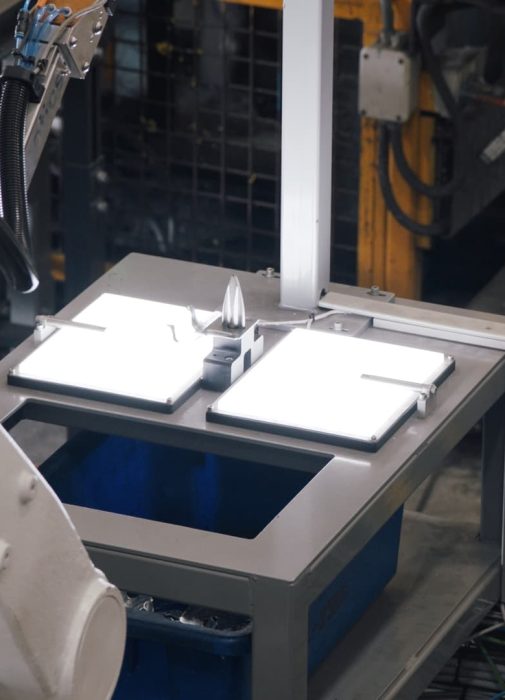
Quality control remains a critical factor in the race for manufacturing excellence, and deep learning vision systems are streamlining this crucial process.
Deep learning vision systems are advanced tools that use neural networks to analyse images and make decisions about product quality.
Unlike traditional machine vision systems that rely on pre-programmed rules, deep learning systems can learn from visual examples and adapt to new situations, making them ideal for complex quality control tasks in manufacturing.
Essentially, they learn whether or not a specific product or component looks correct based on a database of labelled training images that inform its decision-making.
Unprecedented flexibility in quality control
Ryan Hart, Solutions Development Manager at Applied Robotics, explains the fundamental difference between traditional machine vision and deep learning systems.
“Deep learning doesn’t require rules at all. It learns by example and gets better over time,” he said.
“A traditional vision machine looks at a part and says, ‘Does it meet all the criteria we’ve programmed and strictly imposed?’
“A deep learning system says, ‘Does the live image we’re looking at right now more closely resemble the images database trained as ‘good’, or does it look more like images we trained as examples of ‘bad’?’”
“For example, consider the age-old question: ‘How long is a piece of string?’
Would any group of people agree to the exact strict definition? There is no absolute answer.
“The same reasoning applies to a scratch on a door panel: How do you define a set of rules for every variation?
“The scratch can mean something different to each subjective viewer because every scratch is unique.
“Deep Learning, on the other hand, can be trained on a reference library of scratches of different sizes, shapes, colours and contrasts.
“Then, when it sees a brand new scratch that doesn’t look exactly like the others, it can still infer that it is, in fact, a scratch based on the examples.”
The more data you train a deep learning system on, with human experts helping along the way, the better it gets.
The deep learning systems’ judgement is a ‘best guess’, but it is extremely accurate because, unlike a human brain, it literally references every single previous example it’s been trained on before producing its decision.
Maybe some rare people with a photographic memory can do that, but can they do it at 30+ parts per second? This is the power of using deep learning inspections on a production line.
The more data you train a deep learning system on, with human experts helping along the way, the better it gets.
It’s an iterative process where you continue to increase the dataset that each image library is looking at, and then, every day, you will get significant improvements.
Operational Intelligence extends this visibility beyond individual inspections, helping manufacturers identify quality trends and understand how defects relate to broader production performance.
Once trained, there are significant long-term benefits include:
Adaptability – Handle new product variations and unexpected defects without reprogramming.
Improved accuracy – Outperform traditional systems over time in detecting subtle defects.
Reduced false rejections – A better understanding of product variability minimises false positives.
Handling complexity – Excel in scenarios with diverse product lines, blurry margins of error or defects that are challenging to define explicitly.
Continuous improvement – The system learns over time as it’s exposed to more examples.
Real-world applications
In automotive manufacturing, deep learning vision systems detect subtle paint defects and ensure proper assembly.
Food and beverage producers use them to inspect packaging integrity and product consistency, for example to detect organic defects like bruises and insect marks on fruits and vegetables.
In electronics, these systems catch microscopic flaws in circuit boards and components. Even in pharmaceuticals, they’re ensuring the correct shape, size and colour of pills and capsules.
Deep learning in action
AI-powered industrial packing robots cut freight volumes by 50% for Capral Aluminium
Problem
With an ever-changing range of 6,000 unique aluminium profiles plus customisations, Capral Aluminium faced challenges trying to efficiently and safely sort, pick, pack and load orders for distribution to thousands of worksites.
Solution
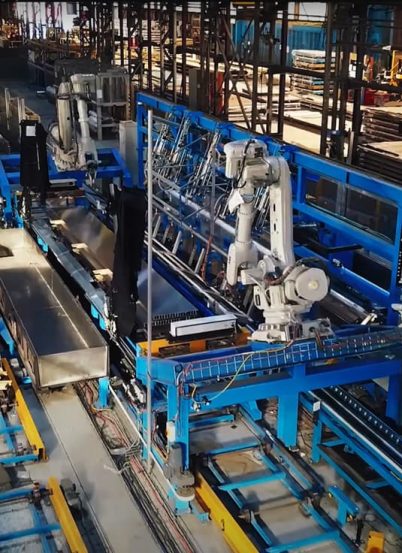
Applied Robotics delivered a turnkey solution integrating the software, AI deep learning vision systems and robotic machinery that intelligently and precisely sorts products into compact packages to cut freight volumes by 50%, accelerate output and power local jobs.
Implementation considerations
Implementing deep learning vision systems for quality control requires careful planning, including:
Diverse dataset – Provide a large, varied set of images for training.
System integration – Integrate the new software with existing systems.
Staff preparation – Train personnel to oversee and work with the new process.
Iterative improvement – Set up processes for continuous system refinement.
Human-AI collaboration – Establish workflows for human experts to verify and provide feedback on AI decisions.
Initially, quality control professionals manually classify a large set of product images as ‘good’ or ‘defective’, teaching the system to recognise various types of defects.
As the system begins making decisions, humans verify its accuracy and provide feedback, helping AI refine its understanding.
This collaboration between human expertise and machine learning is key to developing a reliable, highly accurate quality control system.
However, the potential benefits of improved quality, reduced waste and increased efficiency make it a compelling option for manufacturers looking to stay competitive in today’s market.
“Incidentally, this is exactly why you wouldn’t want to train a robot to be a Terminator,” joked Ryan Hart.