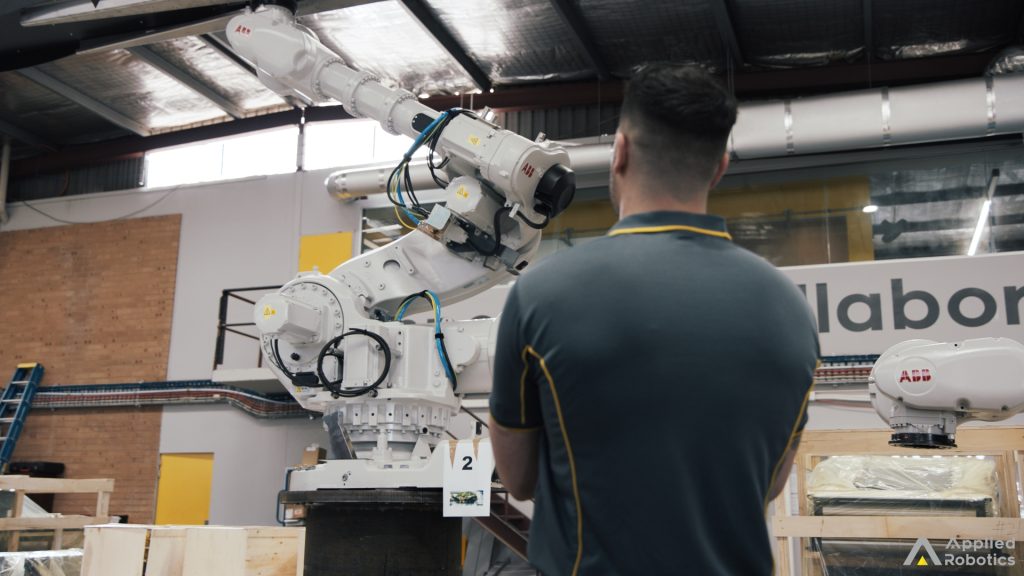
We specialise in custom robot grippers and excel in providing innovative end-of-arm tooling (EOAT) solutions tailored for industrial manufacturing applications.
We excel in providing innovative end-of-arm tooling solutions tailored for industrial manufacturing applications.
Every gripper is developed as part of our Custom Automation Solutions, ensuring it integrates seamlessly with your production processes and operational goals.
Our custom solutions include:
Mechanical robotic grippers
These include hinged grippers that use a pivot mechanism to open and close around an object, and parallel grippers that consist of two jaws that move in parallel towards each other to grip an object.
Magnetic robotic grippers
These grippers rely on magnetic fields to lift and move ferrous materials — without direct contact — ensuring fast and reliable handling without the need for complex mechanical systems.
Vacuum robotic grippers
Relying on suction generated by a vacuum system, these grippers are commonly used for delicate objects or materials with smooth or flat surfaces. Grippers can also be integrated with vision technology to support automated quality control, ensuring products are correctly identified, oriented and handled throughout production.
Multifunctional robotic grippers
Multifunctional grippers are increasingly used in manufacturing as they are adaptable to a wider range of tasks. For example, we worked with Unilever to design a custom gripper capable of inverting the contents of a carton using a turnover table and then collapsing the carton for flat packing.
“My experience working with the Applied Robotics Team has been great and their enthusiasm to take on challenging applications is second to none.”
– Jason L
Rockwell
We offer a full suite of consulting services — together with in-house machine fitting, electrical and engineering services — to maximise the return on your investment.
Off-the-shelf gripper deployment
We will partner with your team to deploy commercially available solutions. These solutions are commonly deployed for machine tending, automated loading and unloading, and material transfer applications:
Billet grippers for industrial robots (including ABB and KUKA)
Billet handling grippers for aluminium extrusion
Carton blank loading grippers for industrial and collaborative robots
Open face carton palletisation
Multifunctional pallet and carton handling.
For complex or high-value applications, a Proof of Concept can validate gripper performance, cycle times and product handling before full deployment
Custom robotic gripper solutions
We will collaborate with your team to design and integrate a custom solution tailored to your unique requirements. Where off-the-shelf equipment cannot meet production requirements, our Special Purpose Machines combine custom robotic grippers with purpose-built automation to deliver complete manufacturing solutions. Examples of our capabilities include the telescopic gripping technologies we designed for Capral’s aluminium extrusion press — capable of functioning in temperatures exceeding 500 °C — and Coca Cola’s carton blank loading solution incorporating laser sensors for dynamic placement.
Gripper refurbishment
It may be possible to extend the life of your existing robot grippers with a full refurbishment service, which includes replacing sensors, actuators and worn components to restore optimal performance.
Gripper replacement and re-design
If your robot grippers are reaching the end of their operational life, we can undertake a complete rebuild using your existing shop drawings or re-engineer them for enhanced performance.
Gripper maintenance
We also offer a maintenance service to maintain optimal performance and prevent downtime.
We are industry agnostic and provide AMR integration consulting services across a wide range of manufacturing sectors, including:
We have partnered with ABB & KUKA, industry-leading robotics and machine automation suppliers.
FAQs
Will I need programming resources to deploy a robot gripper?
You will typically require support including programming languages, simulation software and system integration (even with like-for-like changeovers). We can work with your internal team or undertake this as part of our services.
Are collaborative robots or industrial robots best for carton handling?
Most collaborative robots have a maximum payload of 25 kg (including gripper weight), and are speed-restricted in accordance with Australian standards. If your calculated cartons per minute (divided by two), is more than 12-15kg, this exceeds the capabilities of collaborative robots.
How do I make contact with Applied Robotics to start scoping robotic gripping solutions?
Simply complete and submit our contact form. Our solutions team will get in touch to set up a discovery call.
Learn from our team about how they work together with our clients to build automated solutions and solve complex technical problems.