Australia’s ability to make things locally has never been more critical. However, with smaller markets and higher costs, competing globally demands more than just innovative technology. Our experts reveal how human ingenuity is strengthening Australian manufacturing, one solution at a time.
When our engineers faced the challenge of stacking thousands of carpet tiles per hour at an American factory, the solution didn’t come from advanced robotics or artificial intelligence. It came from a creative question: “What if we reversed gravity?”
Drawing on our textile industry experience, we developed a solution that uses high-flow vacuum technology to suspend tiles beneath a conveyor belt. Gravity then drops them into precise stacks. The result? A system that sorts five tiles per second – ten times faster than conventional methods – using a fraction of the factory space.
While technology enables automation, human creativity drives innovation. In Australia, where lower volumes and higher wages have long demanded inventive manufacturing solutions, we’ve developed a knack for creative thinking that’s opening doors globally.
“We have to be far more adaptable and faster at changing styles,” explains our founder, Dr Paul Wong. “When we develop solutions locally, they inherently have greater flexibility because that’s what our market demands.”
While factories in America, Europe or Asia might dedicate entire facilities to a single product line – like Levi’s with separate plants for men’s and women’s jeans – Australian manufacturers must switch rapidly between styles, colours and sizes, resulting in more versatile solutions.
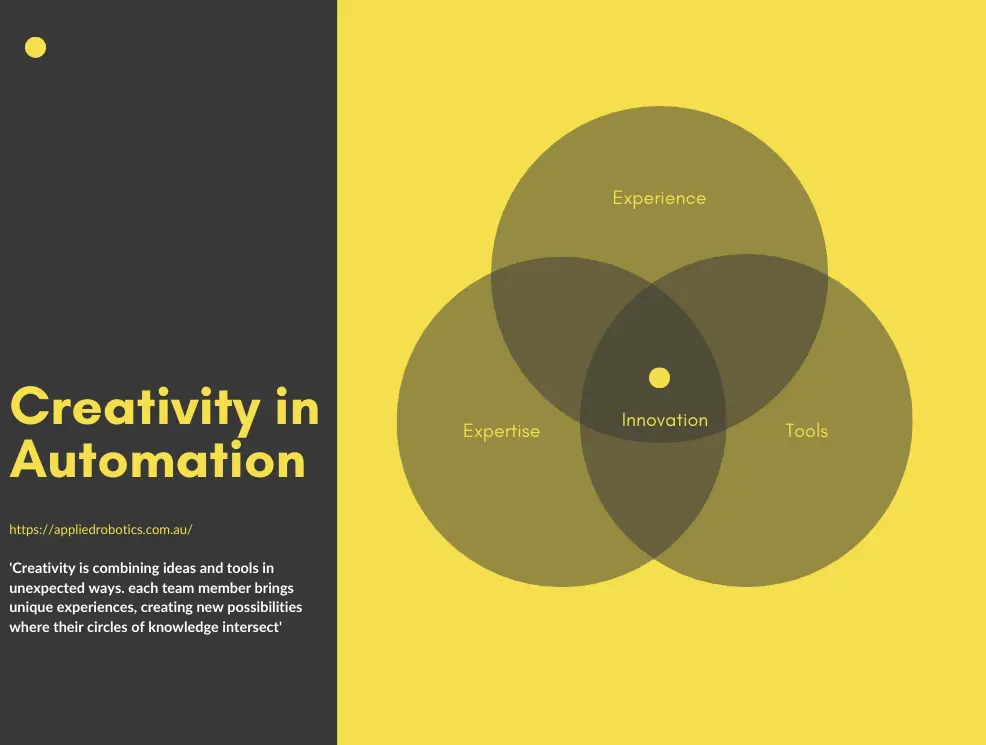
At Applied Robotics, creativity means combining ideas and tools in unexpected ways. Our founder describes it as overlapping datasets – each team member brings unique experiences, creating new possibilities where their circles of knowledge intersect.
It is crucial to create an environment where creativity thrives. That’s why we bring together diverse perspectives, encourage open discussion and ensure every team member – from recent graduates to veteran engineers – has a voice in the solution process.
“The data is important, but creativity – the basic ability to look at data and draw synergies to create solutions – that’s a personal ability people have to different degrees,” explains Dr Wong. “Like any other human ability, mental or physical, it occurs in different degrees.”
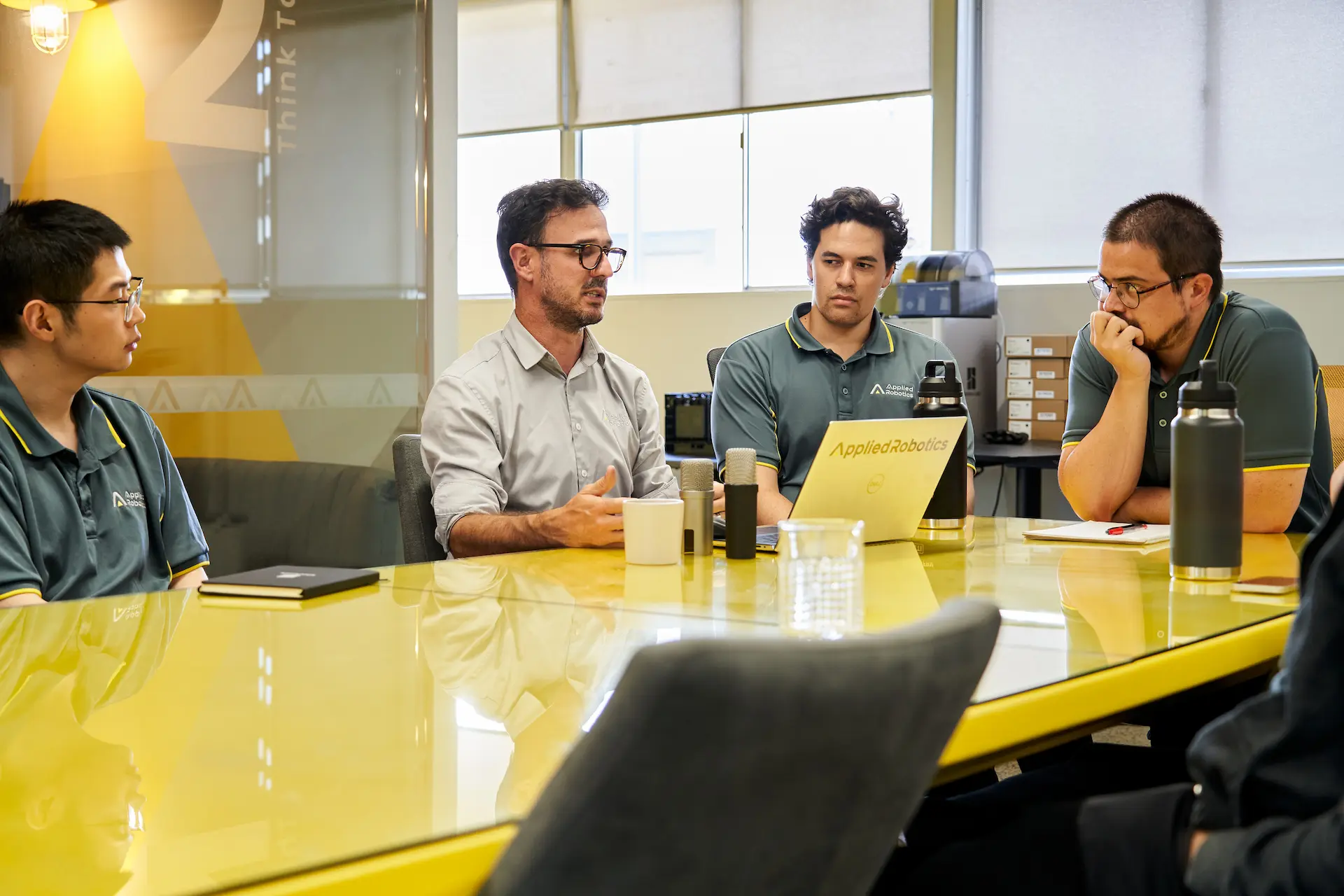
When tackling complex challenges, we bring together mechanical engineers, control systems specialists and production experts. “We may throw out 50 ideas in one session,” says Jacob Mill, our Head of Production. “Each department and individual brings their own expertise and ways of thinking.”
This process has served us well, leading to breakthrough solutions like our AI-powered industrial packing system for Capral Aluminium, which reduced freight volumes by 50%. Combining practical experience with fresh perspectives transforms research and development into commercial reality.
This balance of technology and creativity is crucial. Innovation that creates lasting value is key. Our 1993 system for Buderim Ginger – using pioneering CSIRO Machine Vision Systems technology to sort 45 ginger pieces per second by shape – is still running today, three decades later.
These Custom Automation Solutions combine technologies and engineering disciplines in new ways to solve specific production challenges.
“While emerging AI and advanced software open enormous potential to do more with less, they can’t yet think in the mechanical mindset needed for real-world solutions,” explains Isaac Roach, our Chief Operating Officer. “That’s where human creativity and leadership is essential.”
“Traditionally, industrial automation solutions looked very agricultural, purely functional. A robot can either be rigid and jolty or programmed to glide through the air – almost like it’s dancing,” explains Mill. “We’re showing that solutions can both perform well and look good while doing so, going the extra mile to demonstrate our attention to detail and pride in our work.”
In an assembly system for one of the world’s leading audio technology providers, precision gluing technology and smart sensors work in concert to maintain exacting standards with clean lines and smooth movements that reflect the premium audio brand. For Capral Aluminium, we developed a robotic arm that works gracefully in 600°C environments, precisely positioning hot billets.
From meticulous cable management to smooth movements, these aesthetic considerations signal the precision and care in every system we create.
Unlike many automation companies, we maintain our own in-house production team rather than outsourcing fabrication and installation. “This helps us think on our feet and adapt if there are problems,” explains Mill. “We can put our stamp on things.”
This integration enables rapid innovation. “We can meet with customers, prototype solutions and get back to them the next day,” explains Andrew Hambly, our Solutions General Manager. “Take our work with a confectionery manufacturer where regulations required removing and destroying samples for weight checks. By developing a robot with integrated weighing, we maintained quality control at full production speed without wasting expensive products.”
“Australian manufacturers must think differently,” notes Hambly. “While European factories might use five robots for one process, we must find creative ways to achieve more with less.”
“But this isn’t about replacing workers,” he explains. “When we automated a major food manufacturer’s facility, it retained 130 jobs in Australia that would have otherwise gone offshore. That’s how robotic automation protects and strengthens local manufacturing.”
This drive for efficiency is timely. “Australia’s manufacturing workforce will look very different in 30 years,” says Roach. “We need to upskill people now to meet surging demand with fewer workers.”
“Our vision is to transform Australian industry into a globally competitive manufacturing powerhouse,” says Dr Wong. “By leveraging advanced automation technologies, we can help local manufacturers not just survive but lead in the global market.”
The next generation of engineers and technicians brings fresh perspectives to these challenges. “As breakthrough tech merges with hardware, we’re getting a lot of young applicants looking to get into the industry,” says Mill. “This challenges existing mindsets. Paul seeks ideas from everyone, even the youngest team members, and asks their opinion on how something could be done.”
This blend of experience and fresh thinking is vital for Australia’s manufacturing future. As Dr Wong reflects, “Everyone realises that we have to innovate to be more self-sufficient. That’s a good thing for the Australian industry and, in turn, for people like us who support it.”
We’re building future Australian innovation capabilities through strategic partnerships with multinationals, research institutions, leading universities and local manufacturers.
Our Robotics Education, Courses & Partnerships extend this collaborative approach by connecting industrial automation expertise with the next generation of engineers and technicians.
Our work with TAFE Queensland, developing comprehensive automation training programs, is central to this vision. “We’re helping students and educators see multiple solutions to every problem by combining technical skills with creative thinking,” explains Roach.
The future of Australian manufacturing lies in combining emerging technology and existing tools with the creativity to reimagine what’s possible – backed by the expertise to make it work reliably, day after day.
To explore how creative automation solutions can transform your manufacturing capability, contact our expert team for a discussion.