Australia's premium fluid management equipment manufacturer partnered with Applied Robotics to develop a semi-autonomous assembly solution for industrial hose reels that keeps manufacturing local through smart design and education.
CHALLENGE
Finding a cost-effective automation solution while maintaining quality standards
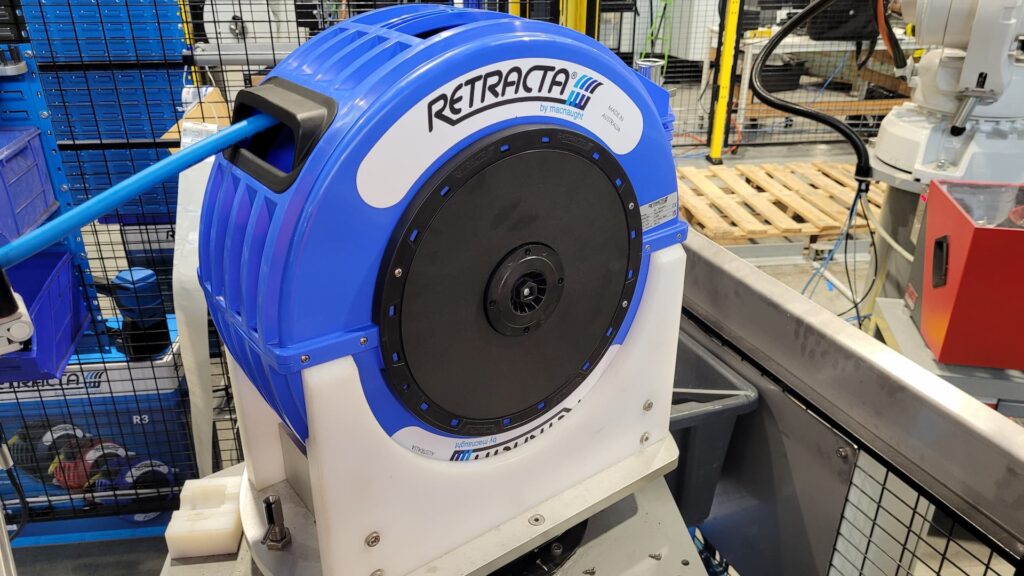
Since 1948, Macnaught has built a reputation for designing and manufacturing premium quality fluid measurement, transfer and lubrication equipment for agricultural, automotive, industrial, mining and transport industries worldwide.
As a proudly Australian manufacturer, Macnaught faces intense competition from low-cost overseas suppliers. To maintain their superior value for money while preserving local manufacturing and quality, Macnaught identified automation as a critical strategy.
The company approached Applied Robotics to automate their industrial hose reel assembly process – a product requiring precise fastening, delicate handling and consistent quality. However, after initial consultations, the proposed automation solution exceeded Macnaught’s budget allocation for this production area.
They’d heard of Applied Robotics due to Dr Paul Wong’s reputation in the industry and initially came to us for a pure automation solution,” explains Andrew Hambly, Solutions General Manager at Applied Robotics.
"But when the proposed capital expenditure proved more than they wanted to commit, we had to get creative with alternative options."
Traditional automation approaches didn’t fit
While they already utilised CNC machines and other equipment in their production, this project was their first venture into flexible, bespoke robotic automation – a significant step in their manufacturing evolution.
Like many Australian manufacturers, Macnaught faced several challenges specific to their production environment:
01
Assembly required repetitive, monotonous manual labour
02
Human operators couldn't maintain consistent fastening torque across shifts
03
The complex components weren't designed with automation in mind
04
The high cost of traditional automation threatened to make the project unviable
Further complicating the situation, some reel assembly tasks involved flexible materials and delicate positioning that would be complex and expensive to automate with standard methods.
solution
Human-robot collaboration cuts costs and improves results
Rather than simply scaling back the automation specification, Applied Robotics took a more innovative approach – helping Macnaught understand how product and component design impacts automation possibilities.
Education as a catalyst for success
Applied Robotics offered Macnaught a specialised workshop on ‘design for automated assembly’ for their engineers and product designers.
“An issue we have in Australia is that many products aren’t designed with automation in mind from the start,” explains Hambly.
“Product designers typically know about manufacturing processes like injection moulding or aluminium extrusion, but they’re often not taught how to design specifically to make automation easier and faster.”
This rethink created a breakthrough
Applied Robotics analysed Macnaught’s products and identified simple design modifications that would make components more automation-friendly.
This included adding orientation tabs to parts to facilitate robotic handling, standardising component interfaces or ensuring consistent part orientation made bulk feeding systems viable where custom handling would otherwise be needed.
“By making these seemingly minor modifications, we could simplify the automation requirements and reduce the capital expenditure significantly. Instead of needing four robots, we could do it with two,” says Hambly.
“Macnaught was so impressed they asked us to educate their engineers on these principles to inform their future product designs.”
Semi-autonomous solution balances human skill with robotic precision
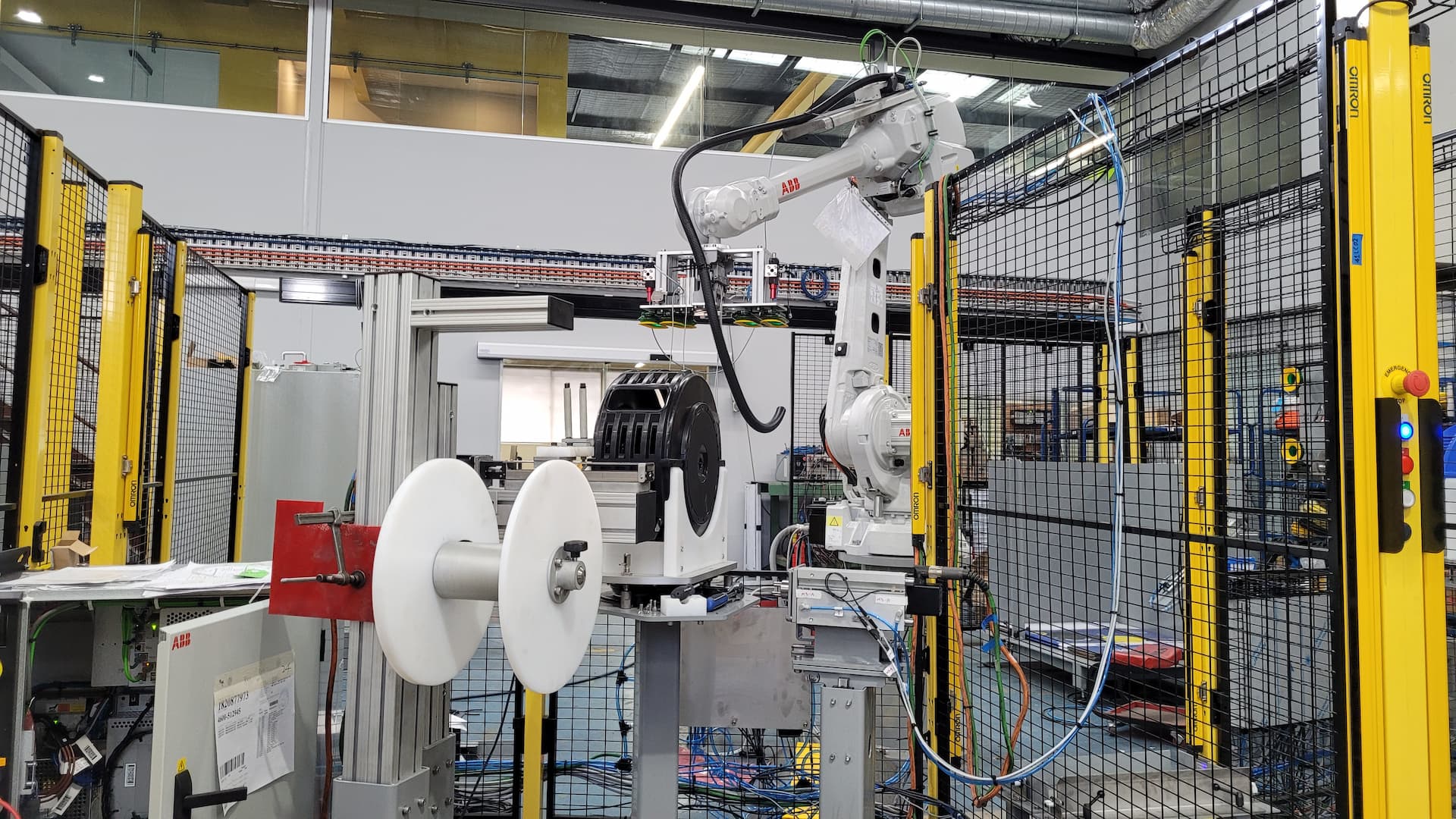
Rather than fully automating every aspect of the assembly process, Applied Robotics developed a semi-autonomous solution that strategically divides tasks between skilled operators and precise robotics:
Operators handle complex, articulated tasks like positioning flexible hose nozzles and tying off cables – easy for humans yet challenging for robots
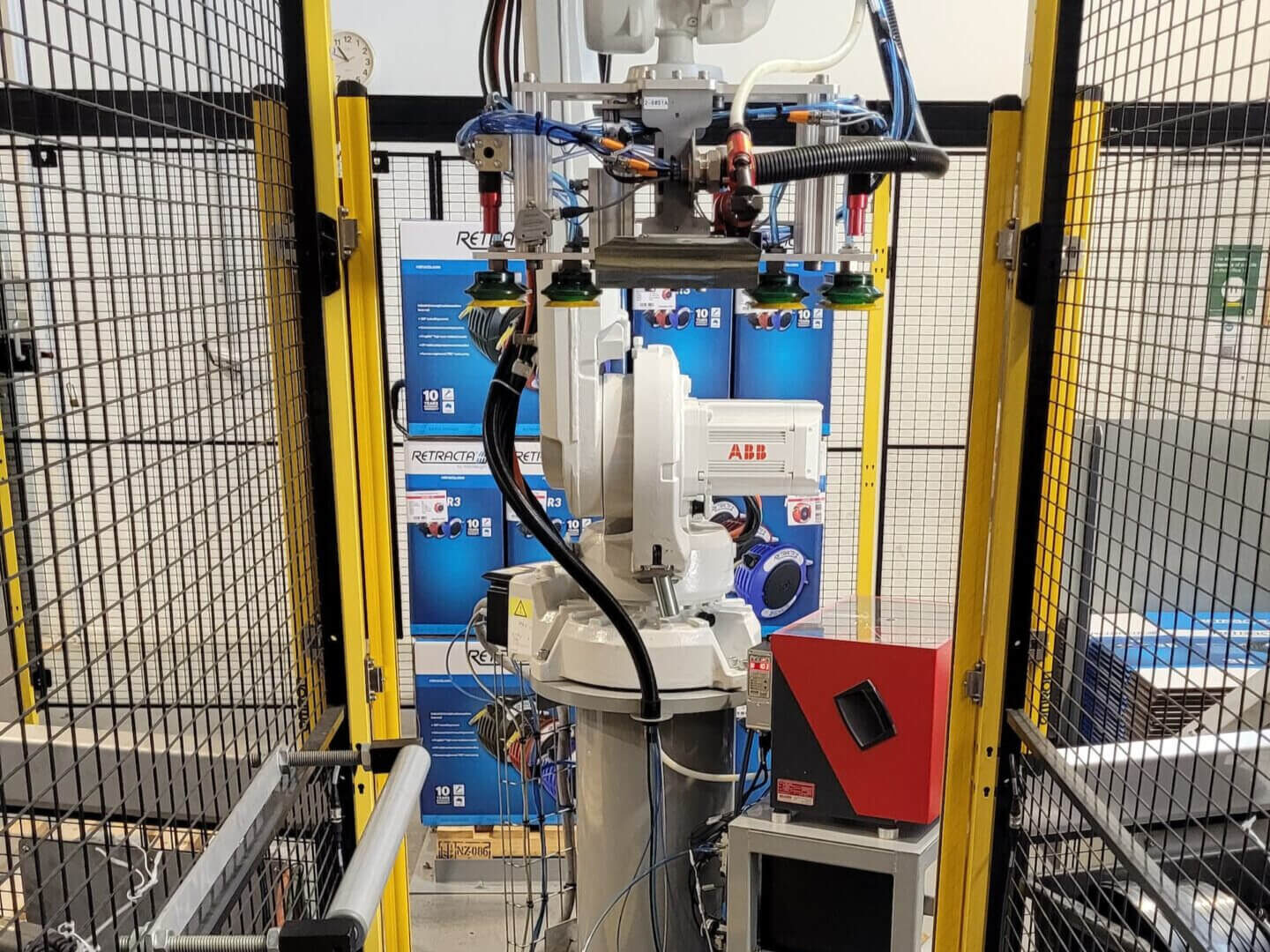
A multi-functional robot performs precise operations like rapidly fastening multiple screws around the reel casing with consistent torque – a fiddly job for people
The cell features a mirrored design where operators prepare the next assembly while the robot works on the previous one, before swapping sides – effectively doubling the output
See how it works
One versatile robotic system – multiple functions
Using one robot for multiple tasks is a cost-effective approach ideal for Australian manufacturing where production runs are shorter with more variations:
Precision fastening with controlled torque that ensures every screw is tightened identically
Automated hose winding that tensions each reel to exact specifications
Complete packaging process including box erection, product placement and palletising
All managed through an intelligent system with multiple integrated tools: programmable screwdriver, suction cups and specialised grippers
Advanced safety systems that enable seamless human-robot collaboration in a shared workspace
results
Precision manufacturing with Australian innovation
The collaborative approach and innovative solution delivered multiple benefits for Macnaught:
Consistent quality with precisely controlled fastening torque for every product
Increased throughput through the mirrored cell design that eliminates wait times
Improved operator experience by shifting monotonous, repetitive tasks to robots while allowing staff to focus on more engaging aspects of production
Complete packaging solution from assembly to palletised, ready-to-ship products
Cost-effective automation designed to meet budget constraints
Enhanced design capabilities with new knowledge integrated into Macnaught’s product development process
Preserved Australian manufacturing by improving competitiveness against lower-cost imports
Building capability for future automation
Beyond immediate productivity gains, this project enhanced Macnaught’s future automation capabilities. Their team is now better informed about automation-friendly design principles and how to manage flexible automation within their business.
“This isn’t just about adding a robot to their production line,” says Hambly. “It’s about helping manufacturers like Macnaught remain competitive while retaining Australian manufacturing. That’s how robotic automation protects and strengthens local manufacturing.”
The partnership showcases how Applied Robotics’ collaborative approach to automation delivers more than just machinery – it builds knowledge, capability and competitive advantage for Australian manufacturers.
To explore how innovative automation solutions can transform your manufacturing capability, contact our expert team for a discussion.