Look inside the $3.6M TAFE QLD Smart Factory training tomorrow's manufacturers
Students train on the same robotics, autonomous mobile robots and control systems they'll use in industry, preparing them for the factory floor of the future with real-world automation technologies. Watch the documentary.
Building on a 30-year partnership with Rockwell Automation, Applied Robotics designed and delivered the advanced manufacturing training lab at TAFE Queensland’s Ipswich campus. The hands-free training environment is a mirror of a real factory floor, scaled for a classroom, integrating robotics, CNC machining, vision systems and digital twin technology.
Funded by the Queensland Government’s ‘Equipping TAFE for Our Future’ program, the Smart Factory Lab was a project Applied Robotics was ready for.
“When this opportunity came up through TAFE Queensland, we jumped at it. It aligns with our vision and commitment to building Australia’s manufacturing future through robotics and local workforce development,” says Isaac Roach, Chief Operating Officer at Applied Robotics.
“It was a tight timeline, and we moved quickly. Our 30-year partnership with Rockwell meant we had the expertise, hardware and software to bring it all together rapidly from end to end.”
See the Smart Factory in action in our documentary:
Inside the $3.6M TAFE QLD Smart Factory – where students train on real industrial robotics and automation
How it works
The facility demonstrates a complete, hands-free manufacturing process – from raw material storage through machining, assembly and quality verification – all managed by Plex, Rockwell Automation’s Manufacturing Execution System. Acting as the operating system for the entire facility, Plex brings everything together, tracking materials and coordinating each step of production.
The process begins at the smart shelf – an automated storage and retrieval system that teaches students three-axis gantry technologies and inventory management. Each pallet is tagged and assigned to an individual student, allowing them to track their work from start to finish.
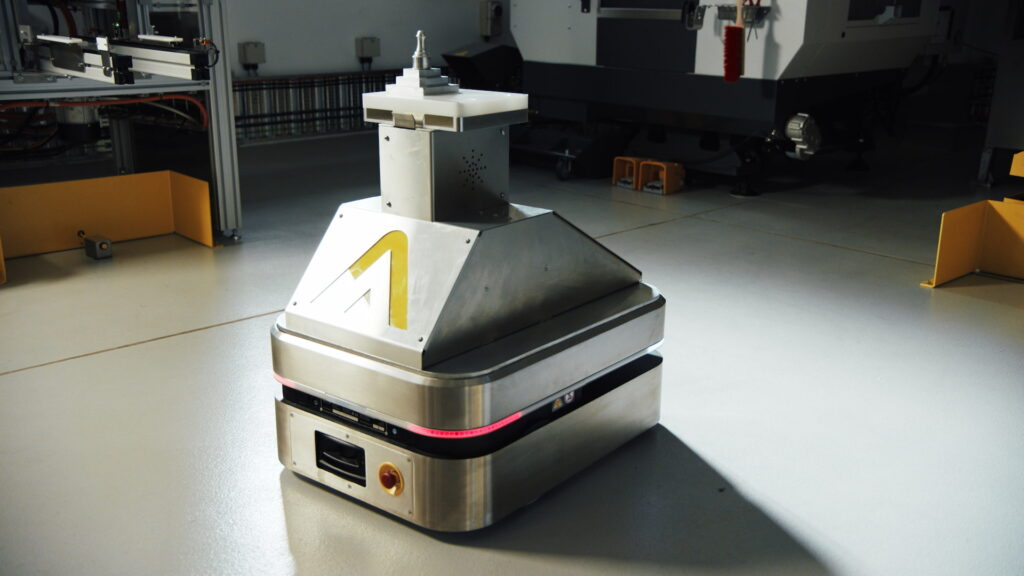
When a job is called, an OTTO 100 Autonomous Mobile Robot collects the tray. It transports it through the facility in one of the first Australian deployments of this material-handling technology.
These autonomous mobile robots (AMRs) are a relatively new technology, so students have the opportunity to develop skills that many in the industry don’t yet have.
The OTTO delivers components to a KUKA industrial robot at the CNC tending station. The robot moves materials between the vision station, a two-axis lathe and a three-axis vertical mill. After machining, components return to the tray for a vision quality check before moving to the assembly cell.
The assembly cell features a five-axis gantry system. A conveyor receives the pallet, sensors confirm positioning, and the gantry picks up the base plate and places it on a rotational table. It then positions the mating component, the table spins and the two parts thread together. A final visual inspection verifies assembly quality before the completed product is returned to storage.
Anthony Wong on how Plex connects every step of the Smart Factory’s digital manufacturing process
Sav Papadopoulos on the OTTO autonomous mobile robots moving materials through the Smart Factory
Bringing theory to life
Alongside the production environment, the facility includes two KUKA Ready to Educate robot learning cells and a KR70 – safe environments for students to develop hands-on programming skills with real industrial robots.
These cells bridge the gap between theoretical training and hands-on experience. Students gain the understanding they need to enter a facility, safely operate and recover robotic systems, and engage confidently with industrial automation.
The Smart Factory is not a simulation – it is real industrial technology configured for education with the same tools they’ll encounter in the workforce.
“Having students studying on current technology and using the equipment they will see in industry when they graduate has enormous benefits,” says Simeon Larrea, General Manager of Software and Controls at Applied Robotics. “They’re not going to be caught off guard. They’re going to be put in the best possible position to succeed.”
Applied Robotics worked with Rockwell to adapt industrial technologies for the educational environment. One innovation is a twinned PLC system that allows students to program and test on one PLC, with the ability to reset to default settings – enabling experimentation without risk.
A key outcome was also training the trainers to ensure TAFE educators are equipped to teach confidently in the new environment.
Graeme Cox on the KUKA robot learning cells giving students hands-on industrial programming experience
Statewide access through digital twin
A key outcome of the project was enabling equitable learning statewide. Applied Robotics achieved this using Emulate3D, Rockwell’s digital twin software.
Emulate3D creates a physics-based virtual environment paired with real controls, allowing students to import actual PLC code and commission systems virtually.
“Rather than accessing that type of technology physically, you can do that in a virtual space,” explains Simeon Larrea. “The benefit is it gives you exposure to how that technology integrates with other parts of the process.”
Students across Queensland can now access the Smart Factory environment remotely, learning the same concepts regardless of their campus location. The facility supports training from Certificate II through to Diploma levels, including courses aligned with advanced manufacturing practices.
Beyond students, the facility is also open to apprentices, industry professionals and manufacturing businesses seeking to upskill their workforces.
Alec Poulton on how Emulate3D digital twins give students statewide access to the Smart Factory
Training the future of a $20 billion sector
The Smart Factory has already attracted interest from other educational institutions seeking similar setups. With Queensland’s manufacturing sector contributing $20 billion annually to the economy, demand for skilled technicians and engineers will continue to grow.
“We’ve really lost a generation of skill set in the country,” reflects Isaac Roach. “We need to upskill this operator level and maintenance level staff to really bring manufacturing back to Australia. That’s why it’s exciting to partner with TAFE on this sort of project – and we’re seeing a lot of movement in Queensland’s advanced manufacturing space.”
For Applied Robotics, the project represents more than a single facility. It’s a model for how industry and education can work together to address Australia’s manufacturing skills challenge.
“Our vision is to transform Australian industry into a globally competitive manufacturing powerhouse,” says Dr Paul Wong, Founder and Technical Director of Applied Robotics.
“By leveraging advanced automation technologies, we can help local manufacturers not just survive, but lead in the global market.”
solution
01
Multi-function gripper for carton handling
02
Robotic decanting of bottles from cartons
03
Flexible programming for different bottle sizes
04
Automated carton collapse after unloading
05
Controlled pivoting hinge for smooth operation
06
Corner-gripping mechanism for full cartons
“Applied Robotics are the providers you engage when you have a unique application that needs to be solved the right way, the first time.”
Adhi W. (Unilever)
results
0% spillage
100% automation of picking, decanting and flat-packing
To explore how custom automation solutions can transform your manufacturing operations, contact our expert team for a discussion.