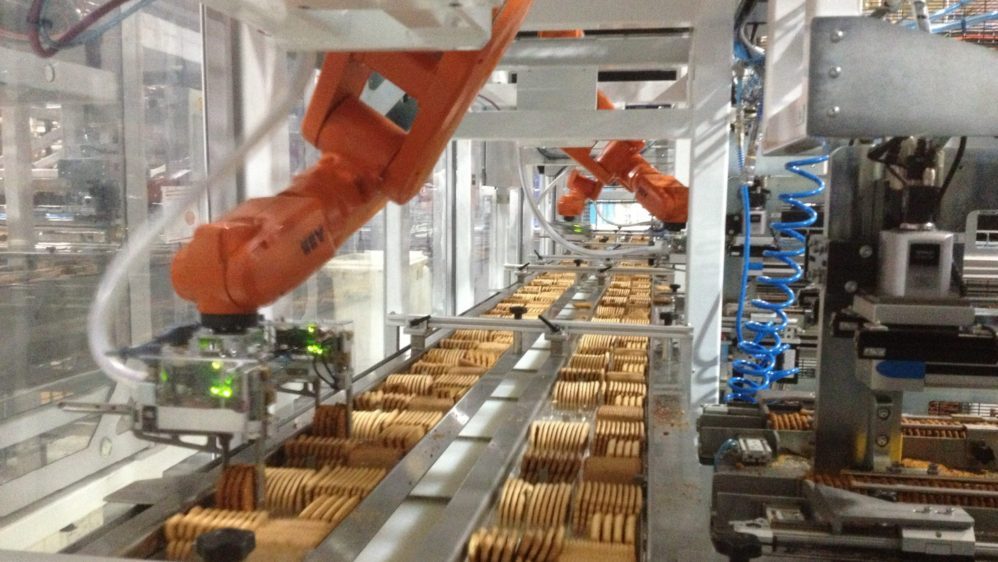
Australia's beloved biscuit maker partnered with Applied Robotics to develop a world-first fully automated assorted biscuit packaging system, transforming a repetitive manual process. Processing up to 105 biscuits per second, it set new standards and strengthened local manufacturing.
Complex assorted packs proved an automation puzzle
Since 1865, Arnott’s has delighted Australian families with its iconic range of biscuits. With over 1,045 products manufactured across 16 sites employing more than 4,000 people, Arnott’s proudly sources 75% of ingredients locally in Australia and New Zealand.
Since the 1960s, Arnott’s has pioneered the automation of their baking and packaging processes for single-variety biscuits. However, assembling the popular assorted packs presented a seemingly impossible automation challenge, requiring individual placement by hand.
From Cream Favourites and Family Favourites to High Tea Favourites and the Cheeseboard Cracker Assortment, these beloved packs feature biscuits such as Monte Carlos, Shortbread Creams, Delta Creams and various crackers arranged in dedicated vacuum-formed trays.
Unlike single-variety packs, which could be automatically packed directly from the production line, assorted packs required a complex and labour-intensive multi-stage process:
01
Bake each biscuit variety separately over multiple days
02
Store biscuits temporarily in airtight containers
03
Manually place each biscuit type into its designated cavity in the vacuum-formed tray
04
Package and distribute the completed packs
"With demand requiring 140 packs per minute, they needed hundreds of operators working across shifts to handle the manual packing," explains Dr Paul Wong, Founder and Technical Director at Applied Robotics.
“This labour-intensive process created challenging repetitive work while increasing production costs and making consistent quality difficult to maintain at such high volumes.”
Standard automation machines were not viable
Facing these challenges, Arnott’s initially approached their traditional European machinery suppliers from Germany and Switzerland, who had provided their single-variety packing equipment for decades.
However, assessing the complexity of delicately handling and placing unique shapes, sizes and delicate compositions into precise packaging, they deemed an automated solution unviable.
Facing higher local costs, Arnott’s was determined to find an innovative and cost-effective solution that could work alongside the existing workforce to maintain the manufacturing of these iconic Australian products on home soil.
“For Australian manufacturers, the challenge is clear – either innovate to stay competitive or risk losing production to overseas facilities.
Our objective was to help Legrand maintain and strengthen their local manufacturing capabilities through intelligent automation.“- Andrew Hambly, Solutions General Manager at Applied Robotics
Watch the assembly process from component feeding to finished product bagging
solution
World-first automation integrates 50+ robots and 64+ vision systems
After evaluating several potential partners, Arnott’s partnered with Australian-owned Applied Robotics to tackle this unprecedented challenge. Rather than adapting existing machinery designs, Applied Robotics developed an entirely new concept centred around advanced robotics, machine vision and an end-to-end approach.
“The traditional European suppliers viewed the problem through the lens of conventional biscuit machinery,” says Andrew Hambly, Solutions General Manager at Applied Robotics.
“We approached it differently, leveraging vision systems and robotics to create a system that could replicate and improve upon the quality and consistency of human operators, while dramatically increasing throughput.”
01
The system captures images of each switch component as it enters the assembly area
Proof-of-concept before end-to-end development
As they were in uncharted territory, Arnott’s and Applied Robotics started with a six-month feasibility study to confirm the approach would work at scale. The team built and tested a single cell that could handle one biscuit variety with the necessary speed, precision and quality control.
After extensive testing proved the concept viable, they built the complete system that transformed the entire assorted pack production process:
01
Baking line unloading robots
Three specialised robotic cells unload freshly baked biscuits from the production line
Vision systems inspect each biscuit for quality, size and appearance
Robots place biscuits into custom-designed storage trays
02
Airtight storage system
Sealed trays maintain freshness until each variety is needed
Automated tracking system manages inventory of each biscuit type
Robotic palletising system stacks and retrieves trays as needed
03
Assorted pack-filling cells
Eight specialised cells along the conveyor handle individual varieties
Custom grippers with force-feedback servomotors provide a feather-like touch that mimics human dexterity
Vision systems verify biscuit quality, cream distribution and structural integrity
04
Integrated packaging line
Filled trays proceed through metal detection, flow wrapping and cartoning
Automated case packing and palletising systems prepare products for distribution
Used storage trays are washed, dried and returned to the system
05
Central control system
Manufacturing Execution System (MES) coordinates all processes in real-time
Production data gathered for analytics and optimisation
Flexible programming for rapid changeover between pack configurations
"What makes this system remarkable is not just its scale, with 100+ robots and vision systems, but the way it also integrates storage trays, metal detection, quality assurance and washing systems to work seamlessly together from start to finish," says Dr Wong.
Machine vision ensures quality control
A critical innovation was implementing advanced vision systems that could replicate and improve upon human quality inspection. These systems verify:
01
Correct biscuit size, shape and colour
02
Proper cream distribution in sandwich biscuits
03
Absence of breaks or damage
04
Consistent positioning within trays
"The vision systems are so precise they can detect even subtle variations in cream distribution or tiny cracks that might be missed by human inspectors, especially after hours on the production line"
Dr Wong.
results
Local manufacturing assured with world-leading innovation
This world-first automation system has transformed Arnott's assorted pack production capabilities since its installation in 2012:
Maintained Australian manufacturing of iconic products
Processing up to 105 biscuits per second with consistent quality and minimal waste
Reduced repetitive manual labour to improve working conditions
Consistent quality control that exceeds human inspection capabilities
Flexible production capacity that can be adjusted to meet seasonal demand
The project established new global benchmarks for what is possible in biscuit packaging automation.
"Applied Robotics brought together a team capable of the design and installation of the largest food and beverage automation project in the World for that year and the largest single food and beverage automation project in the Southern Hemisphere"
Peter Bradbury from ABB Robotics.
The system has been running successfully since 2012, continuing to package the assorted varieties of Arnott’s biscuits found on supermarket shelves today.
Preserving Australian manufacturing heritage through innovation
“This partnership exemplifies how Australian innovation can solve challenges that international suppliers considered impossible,” says Dr Wong.
“By combining Applied Robotics’ automation expertise with Arnott’s commitment to local manufacturing, we’ve created a solution that has kept the production of these iconic Australian products on home soil for well over a decade.”
To explore how custom automation solutions can transform your manufacturing operations, contact our expert team for a discussion.